What the rules allow on your surface
The rules treat brick, stone, render and timber differently.
Read morePlug-in Solar North East / Fitting and sockets
Plugging in is your job and it's easy. Fitting a weatherproof socket outside is an electrician's job. We arrange one if you need it.
The specification is written for a product an ordinary person installs and runs. It also tells the manufacturer to set out where that stops.
You plug the panel in. A qualified electrician tests or alters anything that belongs to the building. That covers the final circuit, the overcurrent protection under BS 7671 section 551.7.2, and any socket you aren't sure about. The instructions have to say so, and they have to tell you to check whether the panel affects your insurance.
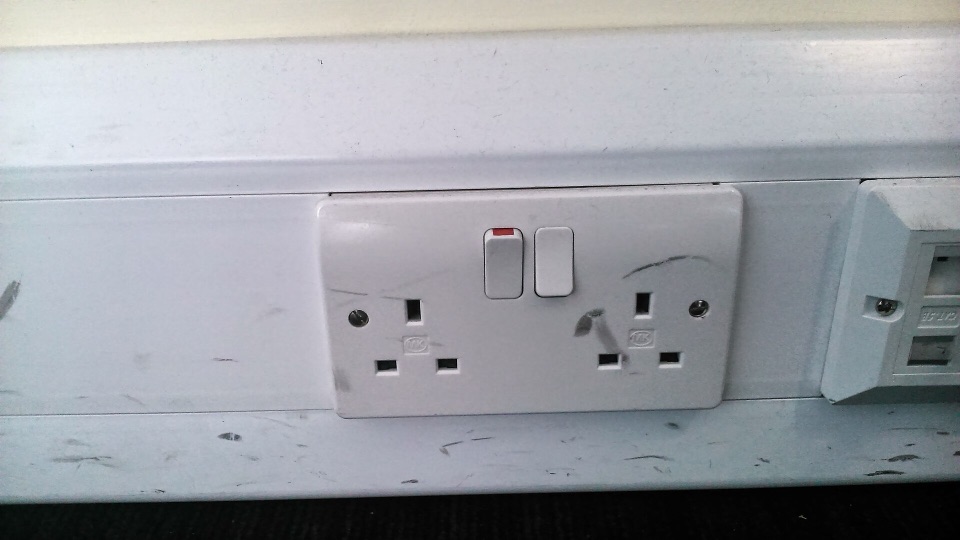
A plug and socket mounted outside the premises means a socket rated IP55 or better. That's the only number in this part of the specification, and it's the one that decides whether an electrician comes out.
Bringing DC cable in from outside is the manufacturer's job as much as yours. They have to supply the connectors and say how the cable should be routed. Those connectors are to BS EN 62852, and only matching pairs from one family go together.
You can't run one off an extension cable, a multi-way adaptor, an RCD adaptor or a travel adaptor. The specification says so twice, once on the device marking and once in the instructions. People often reach for a lead when the panel is out in the yard, which is why the warning is in both places.
The specification permits one device per final ring circuit, then hands the question to the network requirements, which are tighter. G98 Issue 2 Amendment 1 allows one device per household. So the answer is one, and it's the network requirement that sets it.
Within that device, up to four modules may run off the inverter, and no more than two in series in any one string.
Before a device goes on the market its manufacturer has to have it type tested to G98, register it on the ENA Type Test Register and get confirmation that it was assessed as compliant. A kit that isn't on the register hasn't been through that.
There are three numbers worth holding a listing against. Maximum apparent power to the mains is 800 VA, maximum current is 3.5 A, and up to 2000 W of panel may feed it. Panel watts and output watts are different quantities, and a listing that quotes only one of them leaves out the other.
On this page
Not sure your house is suitable?
One postcode and the surface. We will check it.
Check my postcodeYou don't need one to plug the panel in. The specification is written for a product an ordinary person installs and runs. You do need a qualified electrician to test or alter your own wiring, to change the overcurrent protection on a final circuit under BS 7671 section 551.7.2, and to look at any socket you're unsure about.
No. You can't use an extension cable, a multi-way adaptor, an RCD adaptor or a travel adaptor with one. The specification says so on the device marking and again in the instructions. If the socket is in the wrong place, we arrange for one to be fitted.
One. The product specification allows one device per final ring circuit, then points at the network requirements, which are tighter. G98 Issue 2 Amendment 1 allows one device per household, and that holds until it is amended.
It has to be on a register. The manufacturer must have it type tested to G98, register it on the ENA Type Test Register and get confirmation that it was assessed as compliant before it goes on sale. A kit that isn't on the register hasn't been through any of that.
Where were you thinking of putting it?
Tell us your name, postcode and email, and the roof, wall or yard you're thinking of. The reply is an email saying whether the rules allow it and roughly what it would generate.
Replies come by email. Nothing is passed on and nobody pays us commission.
Send us a postcode and a line about the surface. You get an email back with the answer for your own house.
If the rules don't cover your surface, we'll say so. The government expects a planning application to cost more than the panel itself.
Check my postcode